By the middle of the 19th century the use of machines that derived the energy that they required to perform their tasks from the thermal capacity of evaporated water, or steam, was widespread. Steam powered machines were becoming the norm in factories, in ocean-going ships and the ubiquitous railways.
Although some forms of steam energised machines had been around for a considerable time there application was hindered by their low efficiency and consequent implications on the practicalities of fuel use and cost.
Whilst engaged as an instrument maker at Glasgow Collage in the 1760s, the Scottish engineer James Watt was requested to carry out repairs on a model of a atmospheric steam engine of the type produce by Thomas Newcomen, which the Glasgow professors used to illustrate their lectures. In undertaking the repair of the engine Watt was driven to understand the processes by which the machine’s performance was constricted
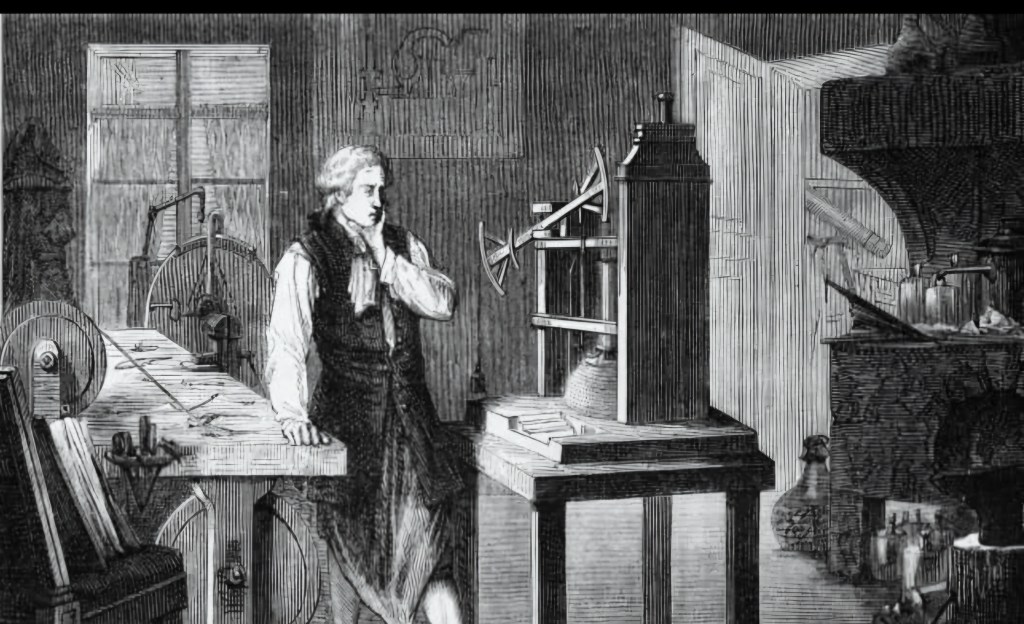
An engraving showing James Watt contemplating the Newcomen engine model in his workshop at the old Glasgow Collage in the City’s High Street in 1765 The engine model remains as an exhibit in the University of Glasgow’s Hunterian Museum.
As a result Watt discovered that it was the repeated, alternate heating and cooling of the engine’s cylinder that so restricted its efficiency and application. To alleviate that restriction Watt proposed to incorporate a seperate condenser, which he patented in 1769, and it was that improvement that led to the steam engine becoming the founding technology of the Industrial Revolution. Watt’s invention vastly increased the efficiency of the machines thereby significantly reducing their fuel consumption and emitted pollutants. By the mid 19th century, when James Watt & Company, run by the inventor’s eldest son, supplied one of the engines for Brunel’s steamship Great Eastern, the development of the steam engine had moved on apace. Much of the 19th century improvements involved the use of higher pressure and superheated steam. With the increasing system pressure and temperature came an increasing litany of serious and fatal accidents many of which were associated with the steam-raising (or boiler) plant.
 A Boilermakers Story